- Information
Article
Description
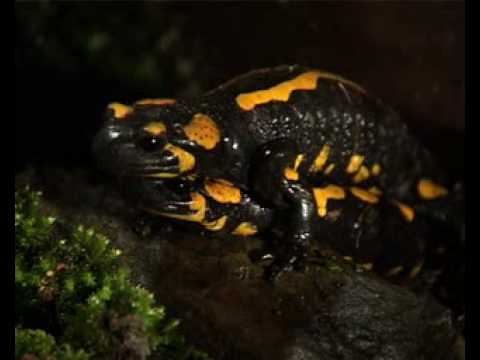
Salamander formidable appearance, wide and slightly plump body with large, robust head. Son of noted Parotid two large glands in the neck, just behind of the eyes. The toes and tail are of circular cross section.
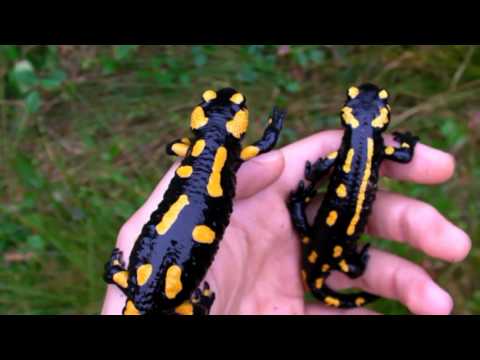
The typical colour corresponds to the pattern of black background on which stand out spots/bands (depending on the subspecies) of an intense bright yellow color.
Exemplary melanic occur with some frequency and exceptionally albinos.
Its rare length time exceeds 20 cm weighing 40 g. Sexual dimorphism is not very pronounced with males more stylized and with a longer tail. The nuptial period present the bulky sewage area. Females are typically more robust, with somewhat shorter legs and greater weight in normal conditions.
Biology:
Animals of slow movements and poor swimmers, their activity is predominantly nocturnal, although humid climates they can be observed even in day looking for worms and small insects.
They live preferably in cool forest areas, in damp places, where they grow mosses and ferns, to an ideal temperature few degrees above the + 10 ° C.
In situations of drought and heat they shelter under rocks, mosses and fallen logs.
Adult salamanders eat centipedes, escolopendras, humidity Woodlice, slugs, snails, termites and ants, flies, spiders, small beetles and their larvae and other invertebrates.
The mating season runs from April to September and mating takes place on Earth. Viviparous, females return to the water to give birth (an average of 30 young 24 to 35 mm) to the following spring. Choose points of clean water and few streams, usually in cool areas with little lit, protected from direct sunlight by trees and stands.
Of solitary habits, the females of the salamanders have espermatecas that allow them to store the male semen (with functional sperm) for some time (years), allowing them to have children without new relations.
The larvae, contrary to the adults, are cryptic and discrete, colored with large gills and a prominent tail. Voracious appetite they preferably feed on worms and crustaceans (such as daphnia and tubifex). If the conditions are suitable, the larvae complete their Metamorphosis from 3 to 6 months, time to leave the aquatic environment to start terrestrial life.
They reach sexual maturity at 2 or 3 years and can live up to 15 or 20, or even more.
Both the juveniles and adults release through the parotid glands and the glandular pores a milky substance that contains a toxin of neurotoxic effects that is a good insect repellent against many predators. Striking drawing of your skin, is also a deterrent to their enemies, as the Association of some colors in nature (aposematosis) indicates signal of danger. Sometimes adopt a defensive posture arching body and showing their colors and parotid glands. It still has natural enemies such as Adders, snakes of collar, some birds and mammals like the polecat or wild boar.
For man, both adults and larvae are completely harmless. Only we must be careful to wash their hands and not touching your eyes or mouth after having manipulated a copy to avoid possible skin irritation in the mucous membranes.
Distribution:
Restricted its distribution to the West of Eurasia, this amphibious Palearctic is distribuye for central and southern Europe, missing in the North, British Isles, Scandinavia, Denmark, Balearic Islands, Sardinia and Sicily.
The species S.salamandra includes various subespècies:
Salamandra salamandra alfredschmidti
Salamandra salamandra almanzoris
Salamandra salamandra bejarae
Salamandra salamandra bernardezi
Salamandra salamandra beschkovi
Salamandra salamandra crespoi
Luxurious salamandra Salamandra
Salamandra salamandra galliaca
Salamandra salamandra gigliolii
Salamandra salamandra longirostris
Salamandra salamandra morenica
Salamander salt. Salamandra - spotted Salamander.
Salamander salt. terrestris - striate salamander.
Salamandra salamandra werneri
| Scientific name | Salamandra salamandra |
Common name
Fire Salamander
Family name
Salamandridae
| Media source | Josep Pascó i Tico, Carles Muntada Godia |
Referees
1 Comment
Collaboration
This article is opened to collaborations. If you wish to contribute with graphic or written material you can do so sending it from here. The author will receive it and then decide to include it or not, citing you as the source of the material.